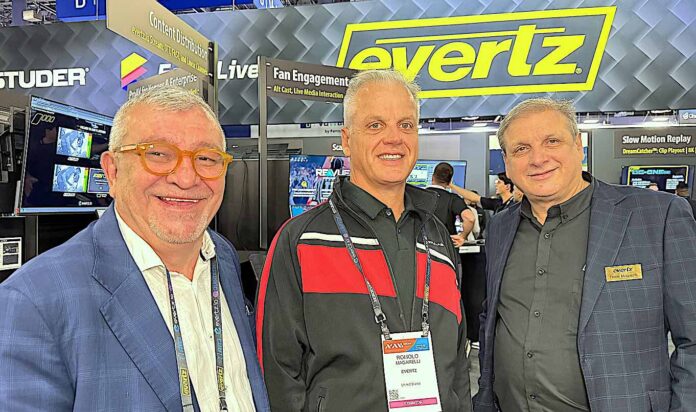
This overview presents the key innovations showcased at the Evertz booth at NAB 2026, with a focus on the Hunter framework and its applications across content creation, signal management, audio control, and infrastructure. The following sections outline how Evertz is advancing content creation, distribution, and audio control for the broadcast industry.
Content Creation — DreamCatcher
The DreamCatcher™ platform serves as the starting point for content creation. The system features a compact DC unit, incorporating the GreenCatcher workflow engine. It supports proCoding of the video signal, with the ability to restore it to its normal state, as well as up, down, and cross conversions, along with routing of sources — all managed from a single control panel.
Panel layouts can be reconfigured with ease to deliver precisely what operators require in order to perform their tasks properly. The guiding principle is to capture once and distribute many times. Content can be shot in multiple formats, enabling the creation of fast channels, with compression or distribution handled as part of the same integrated workflow.
Signal Management — Content Distribution
Once signals are generated, they can be brought in and routed as needed. Whether the destination is LED walls, VIP walls, general-purpose rooms, locker rooms, training rooms, security feeds, production control rooms, or studios, a single capture can be distributed everywhere required, with secure delivery where necessary.
AV over IP Integration — IPMX
All Evertz products are IPMX-certified. Leveraging the IPMX standard, AV products can be bridged into the broadcast ST 2110 ecosystem, with the added capability of fully monetizing all video signals. This enables orchestration, multiviewer, and all-channel fire operations.
Live Production — BRAVO Studio
By bringing signals in through BRAVO Studio, a full production can be assembled entirely from one unified interface. Integrated studio audio control brings studio-grade broadcasting and audio production quality directly into the broadcast world.
Audio Control — Studer / VUE
The entire audio infrastructure has been migrated to a Linux-based operating system for greater robustness, unlocking a range of advanced capabilities. Among the most notable is the audio mic management feature, which enables the deployment of microphones across an entire facility — whether it is a rectangular indoor venue, a racetrack, or any other configuration.
When tracking a car, a puck, a ball, or any moving subject, the system automatically steers microphone pickup toward the relevant area. This process is entirely automatic, allowing microphones to be deployed at scale without the need to manage ambient audio manually. The underlying technology operates through spatial management, aggregating all microphone feeds and processing them collectively.
The result is studio-quality audio — the same standard deployed at major events — rendered accessible through the VUE interface, traditional fader panels for tactile control, or a touch screen for those who prefer a software-driven workflow. Layered configurations and advanced control panel switching are also supported.
C-Band Transition — SDN-RF / RF over IP
One of the key areas of development is RF over IP, particularly in the context of the C-band spectrum being reallocated and repurposed for the 5G network.
Media Core Switch Platform — ENX The ENX switch platform is available in two form factors: an 11RU and an 18RU. The 18RU supports 576 x 576 crosspoint capacity, while the 11RU handles 256 x 256. The platform is entirely agnostic as to signal type, whether baseband, IP, or fiber. Front-panel control surfaces are provided for switching and monitoring operations. A comprehensive analytics suite is included, with the ability to drill down to an individual signal level as required.